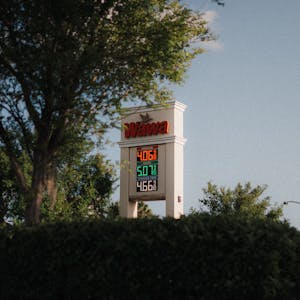
Let us start with the most obvious. Fuel prices are rising. Food is also getting more expensive. And much of that links back to one big cause: the war in Iran.
If you notice the prices rising at the gas stations you are not dreaming. The war which began in late February 2026 started a domino effect. It impacted oil first. Then spilled over to the cost of food and most other daily expenses. The effect of the expanding conflict is being felt by your wallet first.
The Strait of Hormuz Is a Big Factor
The Strait of Hormuz act as a hose that feeds much of the planet’s oil supply. Nearly a fifth of global oil flows through that tight stretch of water. Iran shut it in early March 2026. And that felt like a hand pressing the hose closed all at once.
And as a result the price of oil rose fast. Brent crude went from about $72 a barrel to more than $112. The price had climbed by over half in less than a month . Gas prices at the pump followed fast. In the US, prices climbed 5 to 10 cents per gallon almost every day.
Natural gas got hit too. In the UK, gas prices more than doubled in just a few months. Europe was already running low on stored gas after a harsh winter. The war made things much worse.
Why Does a War in the Middle East Affect Your Gas Bill?
Good question. Most people don’t live anywhere near Iran. So why does a war there mess with your wallet?
Here’s the simple version. A huge chunk of the world’s oil and gas comes from the Persian Gulf. Countries like Kuwait, Iraq, Saudi Arabia, and the UAE produce millions of barrels every day. By mid-March, those countries had together lost over 10 million barrels per day in output. That’s an enormous amount of supply gone almost overnight.
Less supply plus same demand equals higher prices. That’s really it.
Fertilizer, Food, and the Bigger Problem
Here’s where it gets worse. It’s not just gas.
Roughly one-third of the world’s fertilizer goes through the Strait of Hormuz. Fertilizer prices jumped by up to forty percent in the early weeks of the conflict. Farmers need it for crop growth. So when fertilizer gets more expensive, food often does too. The UN projected that global food prices could average around fifteen to twenty percent higher in the first half of two thousand twenty-six if the crisis continued. That is the kind of problem people can feel in a simple trip to the grocery store.
There was another problem too. Countries in the Northern Hemisphere were close to the spring planting season. If farmers used less fertilizer, wheat, rice, and corn harvests could drop. That would tighten food supply over time. And the full effect may not appear all at once. It could take months or even years to come through fully.
What the IMF Said
The International Monetary Fund’s key economists have expressed their severe outlook on the war’s economic impact. Without wrapping it in polite terminology, its economists stated that there will be an economic slowdown, and war’s impact will be felt by the average Joe.
If the war is brief, there will be a spike in prices of goods and services. If prolonged, the war will keep energy prices high and the services remain on the extreme end of inflation. As for the average consumer, this situation is worsened because the creditor countries are indebted and the tools to manage the situation are limited. You can’t spend your way out of a crisis if your pockets are already empty.
Europe Is in a Tough Spot
Europe got hit extra hard. Gas storage was already at just 30% capacity after a rough winter. Then the war knocked out a major source of gas from Qatar. Prices nearly doubled in a short period.
Some countries had more cover than others:
- France and Spain leaned on nuclear and renewable energy
- Italy and the UK had more to lose because they rely heavily on gas for power
- Germany and Italy faced the real threat of a recession by the end of 2026
Industries took a hit too. Chemical and steel makers added price hikes of up to 30% to cover their rising energy costs. Some analysts warned that parts of European industry might not recover if things didn’t improve soon.
Stock Markets Felt It Too
Markets got nervous fast. The Dow Jones dropped over 400 points in early March. European and Asian indexes fell by 1 to 2%. Japan’s index dropped more than 2%.
Some markets fell even harder. South Korea’s stock index suffered its biggest crash since 2008. It dropped up to 12% in a single day. Pakistan’s market fell nearly 10% in one session. Gold prices went up, as they usually do when people are scared. Airlines saw their stock values drop sharply too. Jet fuel prices more than doubled. Many airlines raised ticket prices or cancelled flights just to stay afloat.
What This Means for Everyday People
As gas prices rise, so will the prices of nearly all goods. It takes fuel for trucks and ships to transport products. When delivery fuels become more expensive, so do delivery costs. Prices at stores increase. It’s a cycle, and everyone at the end of the chain is paying more.
Even before the war started, many countries were struggling with inflation. The war only made things worse. Central banks were looking at 2026 to start reducing interest rates, but now they have a more difficult decision to make. Now they are stuck with a tough call: Keep rates high because inflation is so bad. Or reduce rates to stimulate growth.
For the average person, that looks like
- Mortgages times are expensive will stretch
- Increased grocery prices
- A delayed 2026 financial relief
- And that relief may be pushed back a long time again.
The Bottom Line
Wars impact everyone involved, regardless of where the fighting occurs. The Iran conflict revealed the extent of the world’s interconnectivity. One closed strait and gas prices spiked across the world. Fertilizer gets expensive in Kansas. Food prices increase in Tokyo.
When energy supply chains collapse, no one is a winner. Unfortunately, as this conflict continues, the impact will become more severe.